In Septemeber 2008, I traveled 6000 miles to Haiti's Kenscoff mountains. My mission: to care for some of the orphaned and abandoned, the sick, malnourished and premature infants of this beautiful but beleagured Caribbean nation.


Sunday, 24 October 2010

Friday Afternoon

'There is a beautiful baby girl waiting outside for you, Miss Susan, fat and pink! She is 6 days old!' Since they told me that she was 'for me' I knew that the baby had been placed in our care pending adoption, and that she would stay at the main house until her adoption was finalized. I could not contain the smile that spread upwards and reached my eyes.'You see Vivianne, Miss Magaly said, playfully nudging Vivianne, Miss Susan is hapAdd Imagepy, very happy!'

'Send her up to me,' I said. I was still smiling, and yes, I was very pleased by the news. I have admitted dozens of babies to out main house nursery. There is always a sense of anticipation.

Ten minutes later, there were a pangs of grief, where joy should have danced. The baby was pretty, yes, but she was not pink, she was pale. So very pale. She was working extremely hard to breathe. I noted her small, upwards slanting eyes, short neck, and a deep crease, cutting straight across the palm of her hand. Sonya had many of the physical features of Down syndrome. Her toe mails were clubbed, a sign of chronic oxygen deprivation. Even on oxygen, Sonya was blue and her oxygen levels dipped frequently. The baby gazed up at me listlessly. She was floppy. A blood test showed that she was retaining carbon dioxide in her lungs and that the acid levels in her blood were rising. She was critically ill.

Anywhere in the developed world, a baby as sick as Sonya would placed on a ventilator. I had a sinking feeling...... Even if we could find a hospital that would ventilate her, Sonya would never survive the journey down the mountain. Then it occurred to me; we could put Sonya on CPAP. Baby Sophie, who had arrived three days earlier still needed to be on the system. Could we run two? I had the equipment to do that. I would have to make some modifications to the second system to make it operate with the equipment that I had. I didn't know if the circuit would support two CPAP systems. I would have to make it work. Sonya was exhausted. I had no idea whether CPAP would help her, but it was her only chance of survival.

The NICU was highly charged with the activity involved in getting a second CPAP circuit up and running. By the grace of God, a NICU nurse from Canada had arrived the week before, and she was on hand to help with the intense work of getting Sonya onto CPAP, stabilizing and monitoring her. Four hours later, Sonya was on CPAP, IV fluids and IV drugs, She was breathing easily, sleeping peacefully and her blood gasses were almost within normal ranges. I was extremely tired, but elated! I would need this victory to get me through the weekend. One CPAP baby is a lot of work, and now we have two, and both are on IV's and need tube feeds and constant attention and observation. Right now, GLA's NICU is being pushed to the very limit of its capabilities. I will admit to being overwhelmed at times this weekend, and I will share more details about that soon. I am also in awe tonight, though, at what our medical capabilities are, and at what we have been able to do for these babies.

Thursday, 21 October 2010

Sophie Dora

Sophie-Dora made a dramatic entrance into the orphanage at 3:30 am, on Tuesday morning. I was woken from a deep sleep by loud knocking at my door. Someone was calling my name. It was Laurie Bickel. 'The UN and Haitian Police have arrived with a baby from General hospital. They say that she needs oxygen.....' We knew there was unrest in Port-au-Prince. We knew it was not safe to travel a night, and glancing at the entourage that came with this 4lb infant, we also knew that unlike most of our patients, this one had connections.

Sophie was born on Saturday, around 4 weeks early at a private hospital in the city. She had breathing problems and was unable to feed from a bottle. The hospital she was born at did not have facilities for pre-term infants. Only the embattled and under-resourced government hospital would admit her. Sophie-Dora's mother watched on in alarm as her baby became weaker and began having cyanotic spells, during which, she turned blue. Sophie's Mother knew one of our GLA nurses. She was aware of our medical capabilities and, in her estimation, her baby's best chance of survival was to transfer her to us.

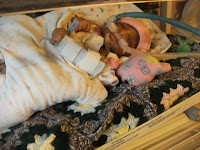
Sophie was extremely pale when she arrived. She had fluid her left lung. Babies are born with fluid filled lungs/ It is possible that this one was too weak to breathe deeply enough to clear this fluid herself. We put her in an incubator and started CPAP to help with her breathing. she is receiving antibiotics and tube feeds. At Sophie's gestational age and weight, the greatest risks to her health are hypothermia, feeding problems and infection. We have seen some very encouraging improvements in Sophie's condition. This morning, she is alert, sucking on her hands and crying 15 minutes before her feeds are due.

I am very thankful to everyone who made it possible for us to obtain the medical equipment that we have, and for everything we can do for some of Haiti's most fragile newborns.

Sunday, 17 October 2010

Reality Bites

Summer is fading away, daytime and night time temperatures have dropped and there are heavy rains every afternoon. The change in climate has ushered in an epidemic of colds , ear infections, and tonsillitis. We currently have 11 miserable babies on antibiotics, pain medication and decongestants. I have had a very busy week assessing and re-assessing sick children, forming treatment plans, prescribing the drugs they need, and monitoring and caring for all of these babies.

Most of them are recovering, but my little Peterson, who was admitted in May for medical assistance, has had constant fevers for 4 days. He is on two antibiotics and he needs Tylenol and ibuprofen around the clock to control his pain and his fever. He has a very poor appetite and I am feeding him every two hours to make sure he stays hydrated and that he gets the nutrition he needs to recover.

Peterson is a medically fragile infant. Although his Mother planned to take him home with her, I think she knew that his chances of survival were very poor in Carrefour, which, is a very impoverished district of Port-au-Prince. To survive and thrive, Peterson would have to be monitored by a multi-disciplinary community medical team, and his mother would need substantial financial aid in order to care for him. This kind of medical and social care network probably will not be realized in Haiti for at least a decade. Peterson's mother relinquished him for adoption a week ago.

The harsh reality that gnaws on my mind this week is that there are thousands upon thousands of Peterson's in Haiti. Many of them will die. I know, of course that my responsibility is for the children in front of me.

Sometimes I think that in my attempts to be positive and hopeful in the blog sphere, I succeed only in sugar-coating reality. If I am brutally honest, Peterson might not survive his health challenges, even at GLA.

Tonight, as I laid him in his crib, I took in his spindly limbs and ashen skin. I could still feel the heat of his feverish body in my arms as I watched him shake his head back-and-forth-back-and-forth-back-and forth. There was no hiding from it; this baby is very weak, and emotionally scared from a short life of neglect and abuse. We will give him the best medical care we possibly can. I will advocate for him, I will hold him and hug him and caress him and pray over him. But will my medicine and my love be enough? I don't know. I just don't know.

Sunday, 3 October 2010

Bye Bye Jeff!

He came to us weighing 3.5 pounds. He was 8 days old and he hadn't been fed since he was born. He was dehydrated, hypothermic and struggling to breathe. We sent him home this week.... He weighed almost 7lb!

Jeff was our second CPAP baby, a living breathing miracle. He came so far in his sojourn, with us, at GLA's intensive care nursery. We will miss Jeff, but we are pleased to have been able to send him home, strong and healthy, to his family.

Had his Mother carried him to term, Jeff would have been born right around now. Many Haitian babies are born weighing 5lb or less, so Jeff is bigger, better nourished and more robust than many of his contemporaries. His young Mother, who was sometimes less than thankful for our work with Jeff and with her, was all smiles and gratitude when she left the orphanage with him.

I believe that we have made a difference in his life - to his chances of going on to live a healthy, productive life. I think that to some extent, Jeff's Mother appreciates this too!

Sunday, 19 September 2010

Developmental Assessments

This week, I did health and developmental assessments on some of the babies at the main house. One of the babies I saw was 6 month old Darline. The information from my assessment, together with formal medical and psychological examinations will help our orphanage staff to match this gorgeous baby girl with a family on our waiting list.Darline came to GLA 2 months ago. At 8 lb, she was significantly underweight. She also had recurrent fevers, that were caused by a mild bacterial infection. My assessment of Darline last week was overwhelmingly positive. I noted that her general health was good and that she had gained almost 5lb since we admitted her to the orphanage in July. Her eating and sleeping patterns were normal for an infant of her age. She was strong, bright, alert, sociable, engaging and doing all of the things that a 6-7 month old infant should be doing.

'Focusing on people and objects and following moving objects through a 180 degree angle.......

Turning in the direction of a shaking rattle and recognising her name...........

Smiling, cooing babbling and giggling........

Rolling from her stomach onto her back and from her back onto her stomach. Sitting. Weight-bearing on her legs. Holding her own bottle. Reaching in all directions and grasping toys. Shaking a rattle. Bringing her hands and her toys to her mouth and chewing on them (this is considered a important aspect of babies development. They learn a lot through the sense of touch).'

Yes, Darline is doing all of those things. She is strong, healthy, beautiful, happy and developmentally, she is right on track. It is very encouraging to see the wonderful progress that she has made in her short time at GLA. There are many, many families who request healthy baby girls. Darline will not have to wait. Somewhere out there, a family is waiting and ready to accept her proposal!

Some of our children, though, have special needs and are not so easy to place. One of the babies I assessed this week did not turn her head to the sound of a shaking rattle. She did not respond to louder noises either. Unfortunately, I won't be able to send her for a hearing test. Our Pediatrician tells me that none of the audiologists in Haiti have the equipment needed to screen for hearing loss in children under the age of four. They are not prepared to cover the the cost of the apparatus (around $6000 USD). At this time, I have concerns about the hearing of four of our main-house children. All I can do is observe them and hope that GLA and their partner agencies will find families for these babies, despite the uncertainties we have about their current hearing and about their development.

Sunday, 12 September 2010

Life-Giving Water

Every morning, just before 7am, I go up to the nurseries to take care of some early morning chores. One of the things I do is prepare special diets for babies that have milk-protein allergies or severe lactose-intolerance.

Many of the children in our care suffer from repeated and prolonged episodes of diarrhoea. This is often precipitated by exposure to viruses, bacteria, and parasites in our drinking water  that cause infection, diarrhoea, vomiting, and damage to the wall of the gut that make our children intolerant to lactose and more vulnerable to other intestinal infections. Lactose intolerance causes stomach cramps and more diarrhoea, which, impairs their ability to absorb nutrients on an ongoing basis, leading to malnutrition and impaired immune function. Chronic diarrhoea is debilitating and it is a real and present threat to children's health, If I suspect that a child's diarrhoea is being caused by or being made worse by lactose intolerance, I put that child on a lactose-free diet, so that diarrhoea and stomach cramps do not impair their appetite and their recovery.On Friday last week, I was excited to see our new water filtration system in operation at GLA's main house. Our previous filtration system was only able to treat our drinking water. We used untreated water for washing clothes, and dishes and for bathing. All of the water that came out of the taps was untreated and many people contracted diarrhoea and vomiting from this untreated water. Many of Haiti's water sources are contaminated, and at GLA, we regularly see the effects of water-borne disease.
Earlier this year, Donley, a premature baby died at GLA, from complications of gastroenteritis. Last year, we had to perform CPR on another infant who became critically ill after contracting diarrhoea. Then, in March, Baby Luc, a low-birth weight, baby became severely malnourished during a bout of diarrhoea and vomiting that almost cost him his life.

Our new water filtration system comes from Water Missions International, an organization that produces mini water treatment plants for communities in the developing world. Their system has the capacity to treat 10 gallons of water every minute. This means that we will now be able to treat all of our water through a highly effective process of filtration and chemical disinfection. The cost of running this apparatus off of our diesel-powered generator: less than $3 USD per 1000 gallons.

Up until now, we were fortunate just to have access to clean drinking water. The majority of the Haitian people are not so lucky. Many Haitian children are habitually sick from drinking contaminated water. Some become so weak from illness and malnutrition that they die.

It shouldn't be this way. I am giving thanks today, to the God who has increased our blessings, and made it possible for us to improve the health of our children. It is my hope that we will see a significant reduction in water-related disease at this orphanage, over the coming weeks and months. It is my prayer that one day soon, every Haitian child will have access to safe drinking water.

Sunday, 5 September 2010

'Nice' Clothes

'Here are some nice clothes for you', Miss Bernadette told one of our young, resident Mothers. The younger woman raised her head and looked down her nose at the scrub sets Miss Bernadette was extending towards her.

'Mesi'(Thanks), the tall, short-haired woman replied, in a low voice, and with an empty expression. Clearly, she was anything but grateful. Miss Bernadette is only a few years older than the sullen young woman in front of her, but she was anything but discouraged. Her smile was unwavering, and her tone was warm. 'We do not wear shorts in this house,' Miss Bernadette explained.

The 'nice' clothes, nursing scrubs, were to replace shorts that were so short that they exposed the woman's thighs. She nodded, lowered her eyes and took the scrubs from Miss Bernadette. Now she understood: they might not be stylish, but all of the nursery staff wore them. The ladies here were making it easy for the young mother to conform to their standards of modesty. As a guest in this house, she was willing to conform to those standards.

Many foreigners consider Haitian fashion backwards. Haiti is a country in which women outside of the cities and the city suburbs prefer to wear skirts and dresses, which are usually knee length. Men are rarely seen out in public topless, and shoulders, busts and mid-rifts are not display. I like that.

Of course, Western fashions do have an influence in Haiti. At God's Littlest Angels, our Haitian staff are exposed to dozens of Christian missionaries as well as visitors from Europe and North America. Many of these Western Christians have far looser standards of modesty than the Haitians do. One of the things that impresses me about the ladies here, and about Haitian Christians in general, is that they hold fast to their own standards. I love that and I respect that. After all, the ways of the world are always changing, but as Christians, we are not supposed to be 'of the world'. Instead, we are called to honour a God who is the same yesterday, today and forever.

As Bernadette clocked off shift tonight, wearing a knee length skirt and a short-sleeved blouse, I remembered her exchange with our resident Mum, and I was proud of her. I wish I had told Bernadette how pretty she looked. Maybe she doesn't need my encouragement, but I think she deserved it.