I asked for prayer: I asked for insight into what Sophie and Sonia needed, This morning, that became perfectly clear - Sophie needed more oxygen, and Sonia needed more lasix. Both babies got what they needed and we saw marked improvements in them, over the course of the day.
At 7am, the power on the second floor went out. The circuit was overloaded. I have never experienced power failure due to overwhelming demand at that time of the day but to prevent further occurrences, I turned off the air compressor and increased the oxygen on Sophie's CPAP. Yesterday, Sophie was pale, floppy and listless. Her jaw was so slack that she could not keep her mouth closed. I had to fashion a home-made chin strap, to keep her mouth closed, so that the pressurized gasses driving the CPAP would not escape. I had serious misgivings about Sophie and the deterioration I was seeing in her.
A few hours after switching her to 100% oxygen this morning, I noticed that Sophie was pink, that her her muscle tone was normal and that she was awake, alert and sucking on her hands again. I turned the air compressor back on and reduced the oxygen, leaving it at a higher percentage than it has been running at before we lost power.
It is now 10:30 pm. I am just back from the NICU. The night nurse called me around 8:30 to review Sonia, a beautiful, chubby baby with a chromosomal disorder that has serious effects on her health. Her airway was closing up and she could barely get air down into her lungs. I gave her two nebuilizer treatments and IV steroids. Initially, she was not responding to treatment. She is on IV fluids again, so that she can rest overnight. Unfortunately, I had to site another IV, since they would not run thorough the line that I have been using for her drugs. She has settled to sleep now, which, I think, is just what I should do.
Wednesday, 27 October 2010


Tuesday, 26 October 2010
Multiplicity
A multiplicity of challenges: that is what baby Sonia is facing. She was assessed today by Dr Nathalie, a Haitian Pediatrician who visits the orphanage every Tuesday. We reviewed her treatment since arriving.
She has been treated for conjunctivitis, possible septicaemia, and pneumonia. She has a very distended abdomen, that could be a sign of digestive tract problems. Yesterday, she developed croup symptoms, and needed steroids and nebulizers to ease her barking cough and open up her swollen airway. She had been fractious and irritable, up until that point. She went on to have a settled day, and I was so glad!
The morning brought some further improvements. Sonia's breathing had improved to the point that she could be taken off of CPAP. It was wonderful to see her round baby face, without all of those tapes and tubes. The new day, also brought new challenges, though. Sonia's face and eyes were puffy, she had gained weight and there was fluid on her lungs again. We strongly suspect that She has a heart defect.
Really, Dr Nathalie, do you think there is a single organ system in her body that is working properly?' I sighed.
It is wrong, wrong, wrong, that babies are born sick. Sonia had a multiplicity of health challenges, that demand a high level of medical and nursing care. She needs constant observation, and I am sure that will continue to be the case over the following days, weeks and months.
I believe that that Sonia and Sophie are here so that, 'the works of God should be manifest,' in them (John 9:3). Thank you to all of you who are praying for me and for these babies. May I be a channel of his love and his healing to them. May I have eyes to see and anticipate their needs, and all the knowledge, wisdom and skill I need to minister to them, for his glory.
Amen
She has been treated for conjunctivitis, possible septicaemia, and pneumonia. She has a very distended abdomen, that could be a sign of digestive tract problems. Yesterday, she developed croup symptoms, and needed steroids and nebulizers to ease her barking cough and open up her swollen airway. She had been fractious and irritable, up until that point. She went on to have a settled day, and I was so glad!
The morning brought some further improvements. Sonia's breathing had improved to the point that she could be taken off of CPAP. It was wonderful to see her round baby face, without all of those tapes and tubes. The new day, also brought new challenges, though. Sonia's face and eyes were puffy, she had gained weight and there was fluid on her lungs again. We strongly suspect that She has a heart defect.
Really, Dr Nathalie, do you think there is a single organ system in her body that is working properly?' I sighed.
It is wrong, wrong, wrong, that babies are born sick. Sonia had a multiplicity of health challenges, that demand a high level of medical and nursing care. She needs constant observation, and I am sure that will continue to be the case over the following days, weeks and months.
I believe that that Sonia and Sophie are here so that, 'the works of God should be manifest,' in them (John 9:3). Thank you to all of you who are praying for me and for these babies. May I be a channel of his love and his healing to them. May I have eyes to see and anticipate their needs, and all the knowledge, wisdom and skill I need to minister to them, for his glory.
Amen
Monday, 25 October 2010
Rewind
Rewind to Friday Morning: Sophie Dora has very mild retractions under her ribs, meaning that even with some respiratory support, she has to work slightly harder than normal to draw air into her lungs.
She deteriorated a few nights ago and had to be started on supplemental oxygen. I turned that off just over an hour ago, to see if she could manage without it. She is a few feet away from me in the incubator. The babies are napping. The NICU is peaceful, but as I watch the rise and fall of Sophie's chest, I am troubled. Her respirations have quickened. She may need oxygen again soon, I think to myself. Sophie's respiratory symptoms are not improving, even though she no longer has fluid on her lungs.
Suddenly, the baby is breathing harder and deeper. Her oxygen level falls. As I walk towards her, she is all ready turning blue, and by the time I reach the incubator, her heart rate is dropping. I turn her oxygen back on, but for an hour after this episode, Sophie is floppy. I draw blood to check her blood gas levels. Sophie barely reacts. The blood gasses are abnormal. I had to try her off of oxygen - if I hadn't I would never have known the limits of her coping - but looking at her now, it dawns on me that something is going on inside her body that I don't fully understand. That something is a very real threat to her life.
When I assessed Sophie on Tuesday morning, I had heard a loud heart murmur. It is becoming apparent that this little girl's heart condition is likely to be significant. Over the weekend, I tired removing CPAP and giving Sophie supplemental oxygen. She managed just 2.5 hours, before her oxygen levels and her heart rate began to drift downwards. She was almost full-term when she was born. Her lungs should be mature. She should not need CPAP at this stage, but she can't manage without it. Without both CPAP and oxygen, Sophie quickly destabilizes.
Tonight, her anxious Mummy asked why the baby still had breathing problems. This child is incredibly precious to her parents and to her extended family, and I think they all ready know that something is wrong. I was gentle and direct. 'Yes, I think we have to investigate that. Lets have the Pediatrician do a thorough examination. And lets see what she suggests.'
Sophie's Mum had been incredibly emotional lately, and that of course, is to be expected of a new Mother of a sick baby. There were no tears during this conversation though. Just straight questions, requiring clear and honest answers.
'If Sophie has a heart problem, can it be fixed?'
I hope that it can. I really, really do.
She deteriorated a few nights ago and had to be started on supplemental oxygen. I turned that off just over an hour ago, to see if she could manage without it. She is a few feet away from me in the incubator. The babies are napping. The NICU is peaceful, but as I watch the rise and fall of Sophie's chest, I am troubled. Her respirations have quickened. She may need oxygen again soon, I think to myself. Sophie's respiratory symptoms are not improving, even though she no longer has fluid on her lungs.
Suddenly, the baby is breathing harder and deeper. Her oxygen level falls. As I walk towards her, she is all ready turning blue, and by the time I reach the incubator, her heart rate is dropping. I turn her oxygen back on, but for an hour after this episode, Sophie is floppy. I draw blood to check her blood gas levels. Sophie barely reacts. The blood gasses are abnormal. I had to try her off of oxygen - if I hadn't I would never have known the limits of her coping - but looking at her now, it dawns on me that something is going on inside her body that I don't fully understand. That something is a very real threat to her life.
When I assessed Sophie on Tuesday morning, I had heard a loud heart murmur. It is becoming apparent that this little girl's heart condition is likely to be significant. Over the weekend, I tired removing CPAP and giving Sophie supplemental oxygen. She managed just 2.5 hours, before her oxygen levels and her heart rate began to drift downwards. She was almost full-term when she was born. Her lungs should be mature. She should not need CPAP at this stage, but she can't manage without it. Without both CPAP and oxygen, Sophie quickly destabilizes.
Tonight, her anxious Mummy asked why the baby still had breathing problems. This child is incredibly precious to her parents and to her extended family, and I think they all ready know that something is wrong. I was gentle and direct. 'Yes, I think we have to investigate that. Lets have the Pediatrician do a thorough examination. And lets see what she suggests.'
Sophie's Mum had been incredibly emotional lately, and that of course, is to be expected of a new Mother of a sick baby. There were no tears during this conversation though. Just straight questions, requiring clear and honest answers.
'If Sophie has a heart problem, can it be fixed?'
I hope that it can. I really, really do.
Sunday, 24 October 2010
Friday Afternoon
'There is a beautiful baby girl waiting outside for you, Miss Susan, fat and pink! She is 6 days old!' Since they told me that she was 'for me' I knew that the baby had been placed in our care pending adoption, and that she would stay at the main house until her adoption was finalized. I could not contain the smile that spread upwards and reached my eyes.'You see Vivianne, Miss Magaly said, playfully nudging Vivianne, Miss Susan is hap py, very happy!'
'Send her up to me,' I said. I was still smiling, and yes, I was very pleased by the news. I have admitted dozens of babies to out main house nursery. There is always a sense of anticipation.
Ten minutes later, there were a pangs of grief, where joy should have danced. The baby was pretty, yes, but she was not pink, she was pale. So very pale. She was working extremely hard to breathe. I noted her small, upwards slanting eyes, short neck, and a deep crease, cutting straight across the palm of her hand. Sonya had many of the physical features of Down syndrome. Her toe mails were clubbed, a sign of chronic oxygen deprivation. Even on oxygen, Sonya was blue and her oxygen levels dipped frequently. The baby gazed up at me listlessly. She was floppy. A blood test showed that she was retaining carbon dioxide in her lungs and that the acid levels in her blood were rising. She was critically ill.
Anywhere in the developed world, a baby as sick as Sonya would placed on a ventilator. I had a sinking feeling...... Even if we could find a hospital that would ventilate her, Sonya would never survive the journey down the mountain. Then it occurred to me; we could put Sonya on CPAP. Baby Sophie, who had arrived three days earlier still needed to be on the system. Could we run two? I had the equipment to do that. I would have to make some modifications to the second system to make it operate with the equipment that I had. I didn't know if the circuit would support two CPAP systems. I would have to make it work. Sonya was exhausted. I had no idea whether CPAP would help her, but it was her only chance of survival.
The NICU was highly charged with the activity involved in getting a second CPAP circuit up and running. By the grace of God, a NICU nurse from Canada had arrived the week before, and she was on hand to help with the intense work of getting Sonya onto CPAP, stabilizing and monitoring her. Four hours later, Sonya was on CPAP, IV fluids and IV drugs, She was breathing easily, sleeping peacefully and her blood gasses were almost within normal ranges. I was extremely tired, but elated! I would need this victory to get me through the weekend. One CPAP baby is a lot of work, and now we have two, and both are on IV's and need tube feeds and constant attention and observation. Right now, GLA's NICU is being pushed to the very limit of its capabilities. I will admit to being overwhelmed at times this weekend, and I will share more details about that soon. I am also in awe tonight, though, at what our medical capabilities are, and at what we have been able to do for these babies.
 py, very happy!'
'Send her up to me,' I said. I was still smiling, and yes, I was very pleased by the news. I have admitted dozens of babies to out main house nursery. There is always a sense of anticipation.
Ten minutes later, there were a pangs of grief, where joy should have danced. The baby was pretty, yes, but she was not pink, she was pale. So very pale. She was working extremely hard to breathe. I noted her small, upwards slanting eyes, short neck, and a deep crease, cutting straight across the palm of her hand. Sonya had many of the physical features of Down syndrome. Her toe mails were clubbed, a sign of chronic oxygen deprivation. Even on oxygen, Sonya was blue and her oxygen levels dipped frequently. The baby gazed up at me listlessly. She was floppy. A blood test showed that she was retaining carbon dioxide in her lungs and that the acid levels in her blood were rising. She was critically ill.
Anywhere in the developed world, a baby as sick as Sonya would placed on a ventilator. I had a sinking feeling...... Even if we could find a hospital that would ventilate her, Sonya would never survive the journey down the mountain. Then it occurred to me; we could put Sonya on CPAP. Baby Sophie, who had arrived three days earlier still needed to be on the system. Could we run two? I had the equipment to do that. I would have to make some modifications to the second system to make it operate with the equipment that I had. I didn't know if the circuit would support two CPAP systems. I would have to make it work. Sonya was exhausted. I had no idea whether CPAP would help her, but it was her only chance of survival.
The NICU was highly charged with the activity involved in getting a second CPAP circuit up and running. By the grace of God, a NICU nurse from Canada had arrived the week before, and she was on hand to help with the intense work of getting Sonya onto CPAP, stabilizing and monitoring her.
Four hours later, Sonya was on CPAP, IV fluids and IV drugs, She was breathing easily, sleeping peacefully and her blood gasses were almost within normal ranges. I was extremely tired, but elated! I would need this victory to get me through the weekend. One CPAP baby is a lot of work, and now we have two, and both are on IV's and need tube feeds and constant attention and observation. Right now, GLA's NICU is being pushed to the very limit of its capabilities. I will admit to being overwhelmed at times this weekend, and I will share more details about that soon. I am also in awe tonight, though, at what our medical capabilities are, and at what we have been able to do for these babies.
Thursday, 21 October 2010
Sophie Dora
Sophie-Dora made a dramatic entrance into the orphanage at 3:30 am, on Tuesday morning. I was woken from a deep sleep by loud knocking at my door. Someone was calling my name. It was Laurie Bickel. 'The UN and Haitian Police have arrived with a baby from General hospital. They say that she needs oxygen.....' We knew there was unrest in Port-au-Prince. We knew it was not safe to travel a night, and glancing at the entourage that came with this 4lb infant, we also knew that unlike most of our patients, this one had connections.
Sophie was born on Saturday, around 4 weeks early at a private hospital in the city. She had breathing problems and was unable to feed from a bottle. The hospital she was born at did not have facilities for pre-term infants. Only the embattled and under-resourced government hospital would admit her. Sophie-Dora's mother watched on in alarm as her baby became weaker and began having cyanotic spells, during which, she turned blue. Sophie's Mother knew one of our GLA nurses. She was aware of our medical capabilities and, in her estimation, her baby's best chance of survival was to transfer her to us.
Sophie was extremely pale when she arrived. She had fluid her left lung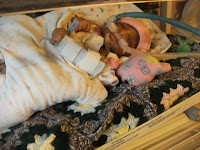 . Babies are born with fluid filled lungs/ It is possible that this one was too weak to breathe deeply enough to clear this fluid herself. We put her in an incubator and started CPAP to help with her breathing. she is receiving antibiotics and tube feeds. At Sophie's gestational age and weight, the greatest risks to her health are hypothermia, feeding problems and infection. We have seen some very encouraging improvements in Sophie's condition. This morning, she is alert, sucking on her hands and crying 15 minutes before her feeds are due.
. Babies are born with fluid filled lungs/ It is possible that this one was too weak to breathe deeply enough to clear this fluid herself. We put her in an incubator and started CPAP to help with her breathing. she is receiving antibiotics and tube feeds. At Sophie's gestational age and weight, the greatest risks to her health are hypothermia, feeding problems and infection. We have seen some very encouraging improvements in Sophie's condition. This morning, she is alert, sucking on her hands and crying 15 minutes before her feeds are due.
I am very thankful to everyone who made it possible for us to obtain the medical equipment that we have, and for everything we can do for some of Haiti's most fragile newborns.
Sunday, 17 October 2010
Reality Bites
Summer is fading away, daytime and night time temperatures have dropped and there are heavy rains every afternoon. The change in climate has ushered in an epidemic of colds , ear infections, and tonsillitis. We currently have 11 miserable babies on antibiotics, pain medication and decongestants. I have had a very busy week assessing and re-assessing sick children, forming treatment plans, prescribing the drugs they need, and monitoring and caring for all of these babies.
Most of them are recovering, but my little Peterson, who was admitted in May for medical assistance, has had constant fevers for 4 days. He is on two antibiotics and he needs Tylenol and ibuprofen around the clock to control his pain and his fever. He has a very poor appetite and I am feeding him every two hours to make sure he stays hydrated and that he gets the nutrition he needs to recover.
the nutrition he needs to recover.
Peterson is a medically fragile infant. Although his Mother planned to take him home with her, I think she knew that his chances of survival were very poor in Carrefour, which, is a very impoverished district of Port-au-Prince. To survive and thrive, Peterson would have to be monitored by a multi-disciplinary community medical team, and his mother would need substantial financial aid in order to care for him. This kind of medical and social care network probably will not be realized in Haiti for at least a decade. Peterson's mother relinquished him for adoption a week ago.
The harsh reality that gnaws on my mind this week is that there are thousands upon thousands of Peterson's in Haiti. Many of them will die. I know, of course that my responsibility is for the children in front of me.
Sometimes I think that in my attempts to be positive and hopeful in the blog sphere, I succeed only in sugar-coating reality. If I am brutally honest, Peterson might not survive his health challenges, even at GLA.
Tonight, as I laid him in his crib, I took in his spindly limbs and ashen skin. I could still feel the heat of his feverish body in my arms as I watched him shake his head back-and-forth-back-and-forth-back-and forth. There was no hiding from it; this baby is very weak, and emotionally scared from a short life of neglect and abuse. We will give him the best medical care we possibly can. I will advocate for him, I will hold him and hug him and caress him and pray over him. But will my medicine and my love be enough? I don't know. I just don't know.
Sunday, 3 October 2010
Bye Bye Jeff!
 He came to us weighing 3.5 pounds. He was 8 days old and he hadn't been fed since he was born. He was dehydrated, hypothermic and struggling to breathe. We sent him home this week.... He weighed almost 7lb!
Jeff was our second CPAP baby, a living breathing miracle. He came so far in his sojourn, with us, at GLA's intensive care nursery. We will miss Jeff, but we are pleased to have been able to send him home, strong and healthy, to his family.
Had his Mother carried him to term, Jeff would have been born right around now.  Many Haitian babies are born weighing 5lb or less, so Jeff is bigger, better nourished and more robust than many of his contemporaries. His young Mother, who was sometimes less than thankful for our work with Jeff and with her, was all smiles and gratitude when she left the orphanage with him.
Many Haitian babies are born weighing 5lb or less, so Jeff is bigger, better nourished and more robust than many of his contemporaries. His young Mother, who was sometimes less than thankful for our work with Jeff and with her, was all smiles and gratitude when she left the orphanage with him.I believe that we have made a difference in his life - to his chances of going on to live a healthy, productive life. I think that to some extent, Jeff's Mother appreciates this too!
Subscribe to:
Posts (Atom)